

How to Evaluate Private Label Liquid Drops: A Sample-to-Order Checklist
PRODUCT DEVELOPMENT / LIQUID DROPS
Evaluate the formula, dispenser and final pack together. A sample becomes useful purchasing evidence when its identity, test conditions and acceptance criteria are recorded.
Updated 22 October 2026 · Procurement workflow and published research
You receive two bottles of liquid drops. Both look presentable. Both suppliers describe their offer as suitable for private label. One quotation includes a bottle and dispenser; the other lists a bulk liquid price. Comparing those prices tells you little about what your brand will receive.
Start with a narrower question: can this supplier provide a documented sample that matches the product, dispenser and packaging you intend to order? The steps below turn that question into a record you can share with development, quality and purchasing colleagues.
1. Define the product you are comparing
Prepare one product brief and give the same version to each supplier. Specify the intended market, ingredient identity, amount per stated serving, serving volume, liquid base, bottle volume and dispenser. Distinguish a measured volume in mL from a counted number of drops. Do not assume that a full dropper equals a stated serving.
Include commercial information that changes the quotation: the first-order quantity, planned packaging artwork, language versions and whether you need a stock formula or development work. Mark undecided fields as open questions. A supplier should be able to identify those gaps rather than filling them with silent assumptions.
| Field | What to record | Why purchasing needs it |
|---|---|---|
| Formula | Ingredient identity and amount basis | Different extract or concentration bases may describe different products |
| Serving presentation | Proposed mL or drop count and instructions | Links the formula to the dispensing task |
| Pack | Bottle, closure, dispenser and artwork version | Separates finished-pack cost from bulk-liquid cost |
| Market | Destination and proposed product classification | Defines the regulatory review needed before sale |
| Commercial scope | Quantity, sample work, tests and delivery terms | Makes exclusions visible before comparing prices |
2. Understand what the research can tell you
A 2014 experimental study evaluated oral medication measuring devices in laboratory and consumer settings. It enrolled 320 adult participants for the consumer component. The reported mean errors were 2% for a syringe, 14% for a cup and 33% for a dropper. These results concern the study’s medicines, devices and conditions; they are not measurements of Nutriphora supplements. Elliott et al., study abstract and DOI.
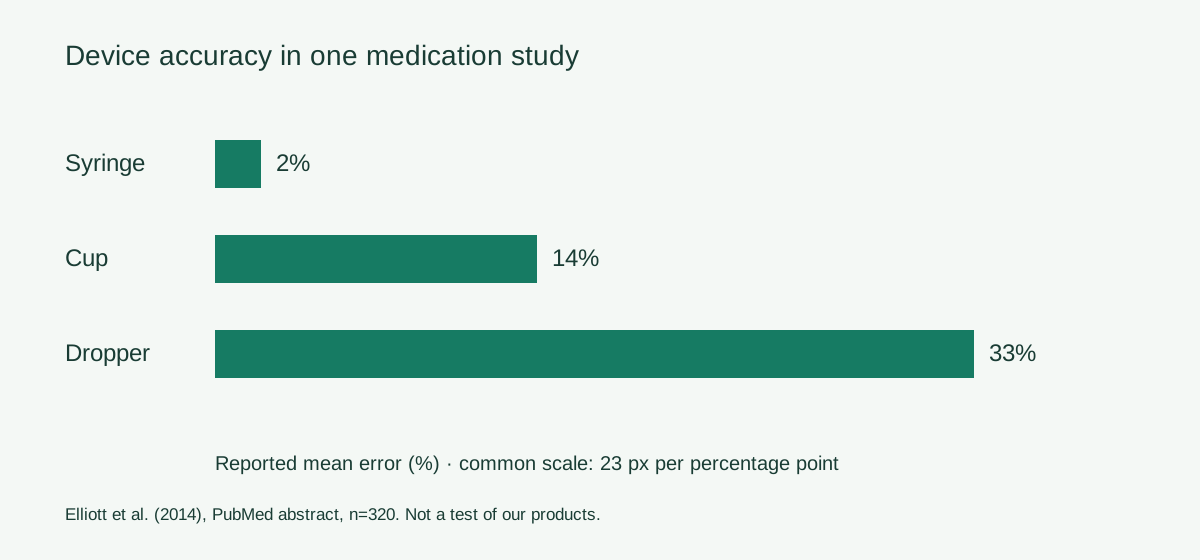
The purchasing implication is to evaluate your proposed liquid and dispensing instructions together. A literature chart cannot establish the performance of a different bottle. Ask for product-specific evidence before accepting a serving claim or choosing packaging on appearance alone.
3. Request a traceable sample package
Ask the supplier to identify the sample by formula revision, batch or sample reference, preparation date and pack specification. Photograph the label, closure and dispenser. Keep a retained sample where practical. An unmarked bottle is difficult to connect to later test reports or production decisions.
Separate the sample specification from the batch certificate of analysis. A specification defines what is intended and how it will be assessed. A report describes results for an identified sample or batch. Check that the report names the tested material, method, date, result and applicable acceptance criterion. If a report concerns an ingredient, do not treat it as a finished-product result.
For a US dietary supplement project, FDA’s CGMP guidance describes specifications covering identity, purity, strength, composition and relevant contamination limits. The applicable duties depend on the operation and product. This purchasing checklist does not establish a supplier’s compliance. FDA dietary supplement CGMP guide.
4. Write a dispenser trial before testing
Define what the dispenser is supposed to do. If the proposed instructions use a marked mL volume, assess that task. If they use counted drops, assess the intended number of drops. Record priming, bottle angle, fill level, temperature and whether shaking is required. Those conditions help another person reproduce the work.
For an exploratory trial, identify the bottles, operators, fill levels and repeated measurements needed to investigate your specific question. Have the responsible technical reviewer select and document the sampling plan. This is a planning checklist, not a validated batch-release method.
A qualified laboratory should select a suitable measurement method. For a gravimetric approach, measure the relevant liquid density under the stated conditions, use an appropriately calibrated balance and document how mass is converted to volume. Do not substitute water density for an oil or glycerin-based blend.
Formula + serving + pack
Revision + bottle references
Method + conditions + raw data
Accept / clarify / repeat
Agree acceptance criteria with the responsible technical and quality reviewers before seeing results. An exploratory trial can reveal a problem or improve instructions; it does not justify inventing a universal pass limit. Record unsuccessful attempts and missing values, with the reason, rather than deleting them from the dataset.
Download the blank sample-record template. It has no results entered. Keep sample identifiers, operator, fill level, temperature, requested serving, measured value, units, method revision and observation notes together.
5. Review the formula and packaging evidence
A dispenser check answers only one part of the sample decision. Ask the responsible reviewers to identify the chemical, microbiological and packaging questions relevant to the actual formula. Request an explanation of how the final bottle, closure and storage conditions are represented in any stability work.
| Question | Useful record | Unresolved if… |
|---|---|---|
| Is this the quoted formula? | Sample identity tied to a controlled formula revision | The report and bottle have different references |
| Does the proposed serving match the delivery system? | Product-specific dispenser method and observations | Instructions rely on an assumed drop volume |
| What supports the storage period? | Relevant stability protocol and available results for the defined pack | A generic shelf-life claim is the only evidence |
| What happens after opening? | Documented assessment of the intended use pattern | Only unopened samples were considered and no rationale is provided |
| Are taste and appearance agreed? | Recorded sample comparison and approval conditions | Different reviewers assess different sample revisions |
Do not convert an attractive sample into a finished label claim. Statements such as alcohol-free, vegan or suitable for a particular market need their own supporting review. Keep those claims in a separate checklist so that they do not disappear inside the general sample approval.
6. Compare quotes against the approved sample
Return the approved sample reference and brief revision to purchasing. Require each quote to state what is included: development, sample iterations, raw materials, filling, bottle and closure, testing, artwork or printing work, freight and any tooling or packaging commitments. Avoid comparing a stocked formula with an unfinished development project as if they were identical offers.
For a reusable comparison, record the quote currency, date, order quantity and delivery terms. Keep unknown costs blank and ask for clarification. Calculate a per-finished-bottle amount only after confirming a common scope. Do not count a missing test charge as zero.
Ask what triggers the production timeline: sample approval, artwork sign-off, receipt of packaging, payment or another agreed event. A headline lead time without its starting conditions is difficult to use in a launch plan.
7. Record the order decision and production handover
Make the decision explicit: approved for the next development step, conditionally approved pending named evidence, or not approved. List unresolved items, their owners and the document revision that will close them. Approval of a development sample should not silently become authorization to release a production batch.
Before placing an order, agree how changes will be handled. A different dispenser, ingredient source or bottle material may require further evaluation. Identify which sample, specification, artwork and test documents production will use, and which records you expect with the finished order.
What this process will not establish
This workflow does not demonstrate clinical effectiveness, legal market access or a shelf life for an unspecified formula. It cannot confirm production consistency from a small set of development bottles. Published medication research provides context for asking better questions; it does not supply acceptance limits for your supplement.
A useful next step is a documented feasibility discussion. Bring the ingredient brief, target market, serving presentation, bottle preference and expected quantity. If those details are still open, mark them as decisions to work through.
Discuss a liquid drops project
Share your product brief and the questions your sample trial needs to answer.
Review liquid manufacturing enquiries Browse liquid product references Send your project briefSources and method
- Elliott JP et al. Influence of Viscosity and Consumer Use on Accuracy of Oral Medication Dosing Devices. J Pharm Technol. 2014;30(4):111–117. DOI: 10.1177/8755122514533780. Numeric chart verified against the PubMed abstract on 22 October 2026. The chart uses the abstract-reported consumer-setting figures, rather than presenting new measurements.
- FDA: Small Entity Compliance Guide for Dietary Supplement CGMP. US regulatory context, not certification of this company.
Editorial method: one published experimental abstract informs the dispensing question; the purchasing tables and proposed protocol are original editorial tools. No systematic literature review, head-to-head supplier test or Nutriphora product-performance dataset is presented.
Discuss this liquid project with the enquiry team — add your formula or product reference, market, pack and quantity.
Latest Popular Articles

Contact


