

How to Improve Flowability in Powder Supplement Processing
USP chapter 1174 is a reference point for powder-flow terminology; no paywalled limits or universal pass value are reproduced here. The greens-powder scenario below is explicitly hypothetical, not a customer case or completed experiment.
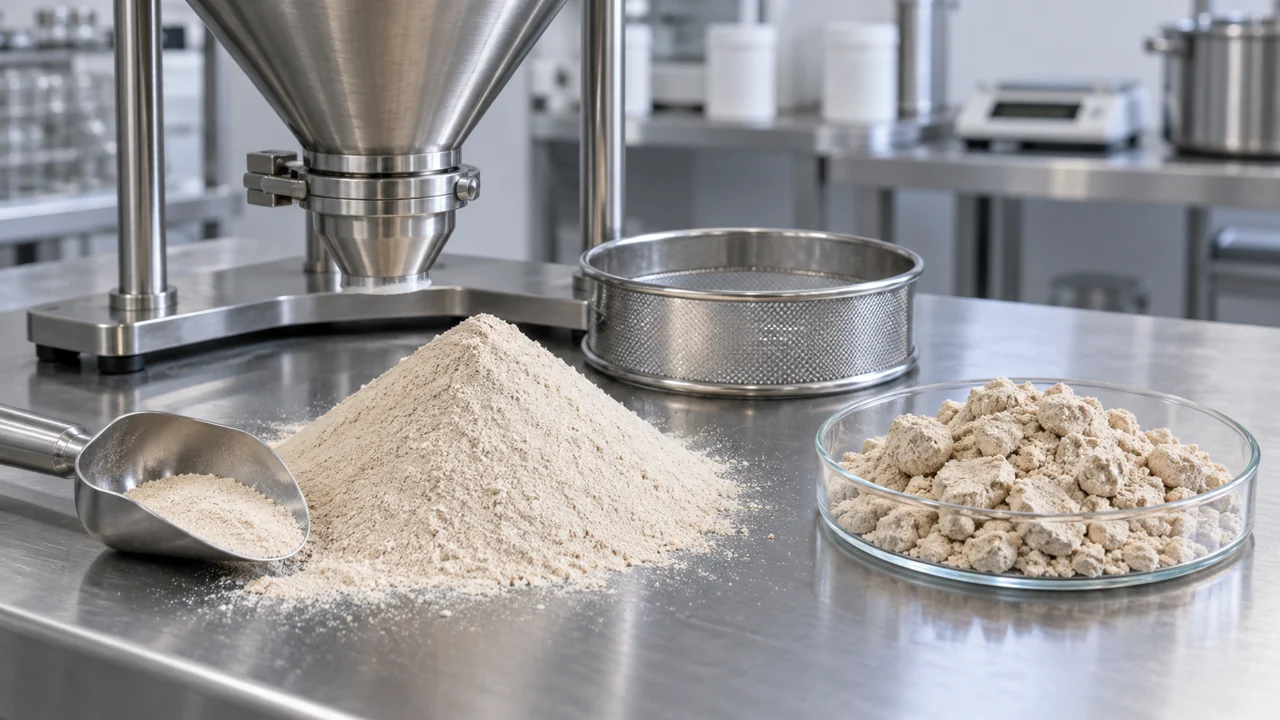
You have approved a powder sample. It tastes right, mixes reasonably well and looks consistent in the jar. Then a larger filling trial begins, and the powder stops moving smoothly through the hopper. Some packs are light, others are heavy, and the operator keeps interrupting the run. What changed?
The formula may be the same, but the conditions are different. A powder that pours from a small sample container may behave differently after storage, transfer and time under its own weight. To solve the problem, you need to understand both the material and the process. Adding a flow aid is one option; it is not the starting point for every investigation.
What good powder flow actually means
For a supplement manufacturer, good flow means that powder moves predictably through the equipment used for that product. That matters during transfer, hopper discharge and filling into jars, sachets or stick packs. It also matters that the blend remains uniform as it moves. A powder can discharge quickly and still separate into fractions with different ingredient concentrations.
Flow is not the same as dispersibility. Your powder may fill well but form lumps when a customer stirs it into water. It may also disperse well in a drink while being difficult to handle on the packing line. Keep both requirements in the development brief so that improving one does not quietly compromise the other.
USP's Powder Flow chapter describes powder behavior as multifaceted. That is a useful reason to avoid treating one flow measurement as a complete prediction of production performance. Ask the technical team which assessment suits the material and the operation you are investigating.
Start with the symptom, not the proposed additive
“The powder does not flow” leaves too much unanswered. Does it form a bridge above the outlet? Does discharge become uneven after the hopper stands for a while? Is powder sticking to a transfer surface, or does the problem only appear near the end of the run? Record where and when the behavior changes.
| What you observe | What to investigate first |
|---|---|
| Intermittent discharge or bridging | Material condition, time in the hopper, outlet geometry and feeding settings. |
| Clumps after holding or storage | Exposure history, moisture results, container closure and storage conditions. |
| Fill weights drift during a run | Feeder behavior, hopper level, changes in bulk density and possible segregation. |
| Powder adheres to equipment | Contact surfaces, electrostatic effects and the environmental conditions at that step. |
These observations are starting points, not diagnoses. Keep the ingredient lot numbers, blend version, equipment settings and environmental records with the trial results. Without that context, a successful repeat may be difficult to explain or reproduce.
Five material factors worth checking
Particle size and size distribution
Very fine particles can be cohesive and dusty. Blending materials with different particle sizes may also create opportunities for segregation during handling. Look beyond the average particle size: ask whether the distribution changed between ingredient lots and whether the receiving specification captures the characteristics that matter.
Sieving, controlled milling or agglomeration may help in an appropriate formulation. Each changes the material in a different way. Milling simply to make everything finer can make a handling problem worse; making larger particles may change how the finished powder disperses. Compare the result against both production and consumer-use requirements.
Moisture and exposure time
Investigate whether moisture exposure is associated with the observed change in powder behaviour. Some materials become sticky or cake during exposure, but you should not assume that every collagen, mineral or botanical powder behaves identically. The grade, carrier and formulation matter.
Compare powder sampled directly from a closed container with powder held under the actual trial conditions. Also check how long bags stay open and how intermediate blends are covered. A storage or handling change may be more relevant than a formula change.
Particle shape and surface texture
Irregular particles interact differently from smoother particles. This helps explain why two materials with a similar ingredient name can behave differently in a feeder. If a supplier changes a grade or processing method, consider its handling behavior as well as its chemical specification.
Electrostatic effects
Powder adhering to surfaces can complicate transfer and filling. Have the engineering team assess grounding, contact materials and static-control arrangements. Do not solve a suspected static problem by casually increasing humidity: moisture-sensitive ingredients may introduce a different problem. Review the environmental limits for the whole product.
Density differences within the blend
A multi-ingredient blend may contain materials with substantially different bulk densities. Transfer, vibration or repeated handling can contribute to separation. When you assess a proposed flow improvement, check blend uniformity as well. More rapid discharge is not an improvement if the composition reaching the filler becomes less consistent.
Choose a correction that fits the cause
If the material is the main issue, the formulation team may consider a different ingredient grade, particle-size control, agglomeration or granulation. Wet and dry processing introduce different conditions, so the choice needs to account for ingredient sensitivity and the final product's performance. Neither method should be assumed suitable for every powder supplement.
A flow aid or anti-caking ingredient may be appropriate. Its identity and amount need to fit the formulation, intended market and labeling requirements. Ask what the trial is intended to improve and which other attributes will be checked. Avoid accepting an additive solely because it worked in an unrelated protein blend.
If the problem develops during blending or transfer, review addition sequence, mixing conditions and the handling steps after mixing. More mixing is not automatically better. The accepted process should preserve the blend's required uniformity through to filling.
Equipment changes deserve the same care. Hopper geometry, outlet size, surface condition and feeding arrangements can influence discharge. Vibration or mechanical assistance should be evaluated for this material rather than added by default. Ask whether the proposed setting remains effective across normal hopper levels and planned holding periods.
Hypothetical trial: a greens powder that bridges after a pause
Consider this hypothetical trial. A greens blend fills satisfactorily at the start, but discharge becomes intermittent after a production pause. Changing several ingredients immediately would make it difficult to identify the cause.
A more useful first trial compares the same blend under recorded holding conditions. The team checks the powder before and after the pause, notes the hopper level and examines whether the feeding settings or material condition changed. If a different ingredient grade is then proposed, it is tested against the reference blend under comparable conditions.
The approval question becomes specific: does the revised material discharge consistently after the intended hold, maintain the required composition and fill performance, and still deliver the agreed taste and dispersibility? That is more useful than a general statement that the new powder “flows better.”
What to ask before approving the change
Ask for a short explanation of the suspected cause, the trial conditions and the observed result. Identify which formula, material specification or equipment setting has changed. Agree which further checks are needed before routine production, including any impact on labeling, packaging or stability work.
For a new project, share the intended serving, pack format and way the customer will prepare the product. Those details help connect manufacturing behavior with the experience you want the finished supplement to deliver.
Common questions
Can we use the same solution for protein, collagen and botanical powders?
Not without checking the actual materials. Those category names cover many grades and blends. Use them to describe the project, then investigate the specific behavior rather than prescribing a category-wide fix.
Is a successful small sample enough?
It is useful development evidence, but it does not reproduce every production condition. The relevant transfer, holding and filling steps still need to be evaluated at an appropriate scale.
Should we change the packaging too?
If the problem appears during storage, review the package and exposure conditions alongside the powder. A process correction alone may not address a storage-related issue. The decision should follow the investigation rather than a routine switch to a different container.
Related development decisions
Record a change so the trial can be interpreted
| Record | What to connect |
|---|---|
| Symptom | Equipment stage, time after a pause, environment and observed behaviour. |
| Material | Blend revision, lot, exposure and relevant measured properties. |
| Change | One identified processing or material change and its rationale. |
| Outcome | Observation method, raw records, remaining risks and approval decision. |
Continue the specific development decision
Related Reading
Browse the product references below, or send your own formula brief. Confirm the composition, packaging and sample requirements for the project you want to quote.

Contact


